
Software Engineering KPIs: The Metrics That Actually Improve Delivery
You probably have plenty of engineering KPIs already. Dashboards, charts, cycle time, PRs, velocity, defects. The harder question is whether it actually explains what’s happening in your SDLC. The problem is that many Agile metrics focus on output rather than system performance.
That question matters even more now. AI can increase output quickly. But if reviews slow down, quality drops, or delivery becomes less predictable, we haven’t improved the system. We’ve just put more pressure on it.
So, the job of software development KPIs is to show whether software delivery performance is really improving.
In this article:
What are the most important software development KPIs?
Which software delivery metrics matter, and why?
How can we measure the impact of AI, and AI adoption in software engineering?
What are the most important software development KPIs?
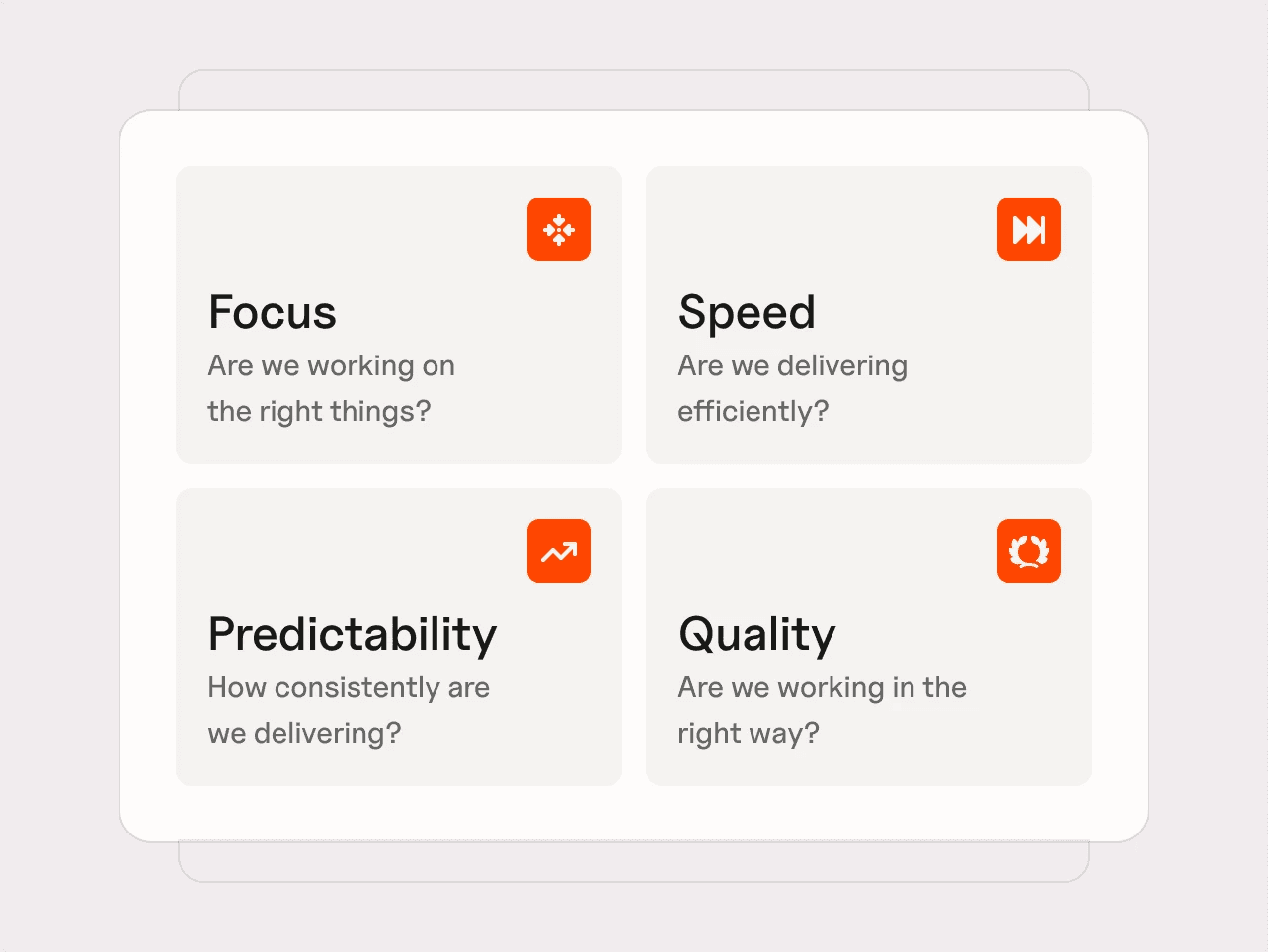
We group engineering productivity into four core dimensions, called the Four Pillars of Engineering Productivity. Together, they give a balanced view of how teams deliver software, avoiding the trap of over-optimizing for speed alone:
We analyzed the data of 2000+ engineering teams to understand why there are performance gaps in our 2026 Engineering Productivity Benchmarks. Using this, we identified the software delivery metrics that really matter, and why, and how, they are crucial to understanding software development productivity.
Statistics from this article are taken from the Engineering Productivity Benchmarks research, which you can read here.
Focus – are we working on the right things?
Focus measures how much engineering effort is spent delivering new value vs maintaining the system. If this balance is off, improvements elsewhere won’t translate into meaningful progress.
Key metrics:
Value Delivery % – proportion of work contributing to roadmap outcomes
Support & Maintenance % – capacity consumed by bugs, incidents, and upkeep
Low-performing teams often spend as little as 20% on roadmap work. When reactive work dominates, delivery slows regardless of team speed.
Speed – how efficiently does work move?
Traditional frameworks like DORA metrics focus on speed and stability. Speed is about flow through the system, not how fast code is written. Most delays happen in waiting: reviews, testing, and release.
These are often grouped with DevOps metrics, but need to be interpreted in context.
1. Lead Time to Value
Time from idea to production. Research from our software delivery benchmarks shows Lead Time to Value is often 5x longer than cycle time, making it the biggest opportunity for improvement.
👉Expert tip: Top performing teams achieve <22.5 days
2. Cycle Time
Time from work starting to production. A core indicator of delivery efficiency and workflow health.
👉Expert tip: High-performing teams regularly review cycle time to spot anomalies
3. Time to Merge PRs
Tracks review and integration latency. Teams under 24h see significantly faster delivery and fewer conflicts.
👉Expert tip: This metric typically accounts for 20-30% of cycle time and highlights opportunities to improve collaboration.
4. Throughput Quotient
Output normalized by team size and cycle time. Shows true efficiency–not just volume.
👉Expert tip: Breaking this metric into core components highlights opportunities to optimize workflow efficiency and reduce bottlenecks.
5. PR Efficiency Quotient
How effectively PRs convert into merged output. Highlights collaboration quality and review bottlenecks.
👉Expert tip: This metric can incentivize teams to break PRs down into smaller PRs which are easier to understand, reducing review times and increasing the chance of catching bugs.
6. Merge Frequency per Author
How often engineers integrate changes. Higher frequency → smaller changes, faster feedback, fewer conflicts.
Predictability – how consistently can we deliver?
Predictability measures how reliable delivery is over time. Without it, planning becomes guesswork.
1. Sprint Capacity Accuracy
Calculated as the total velocity of a sprint (i.e., the total completed tickets that were ever included in the sprint) divided by the initial commitment (i.e., the tickets initially planned for the sprint).
👉Expert tip: This metric is a critical tool for understanding a team's true delivery capacity, revealing how much work they can realistically accomplish in a sprint.
2. Sprint Target Completion
Percentage of committed work delivered. Core signal of planning + execution quality.
👉Expert tip: High-performing teams will aim for sustained completion of 80-90%.
3. Mid-Sprint Scope Change %
How much work shifts during a sprint. High levels undermine predictability and indicate planning issues.
👉Expert tip: The top 25% of teams will aim for 58% and below mid-sprint scope change
4. Velocity Volatility
How stable delivery is over time. High volatility signals inconsistency and risk.
Quality – are we delivering sustainably?
Quality reflects whether speed is sustainable or creating future work. Short-term gains often degrade long-term engineering performance, leading to bugs and unplanned technical debt.
1. Bug Resolution Time
Time to fix defects. Longer times increase backlog, reduce capacity, and slow future delivery.
2. Stories Delivered : Bugs Raised
Tracks whether new work is introducing defects.
👉Expert tip: Should be analyzed as a pair of converging or diverging metrics, not as standalone metrics.
3. Bugs Resolved : Bugs Raised
Indicates whether teams are keeping up with defect load or accumulating debt.
👉Expert tip: The top 25% performing teams will resolve as many bugs as they raise (or better).
How should we measure the impact of AI on engineering productivity?
Activity alone doesn’t equal productivity. We divide AI metrics for software engineering like this:
Diagnostic signals show adoption and behavior
Constraint metrics reveal where the system is under strain
Outcome metrics prove whether productivity has actually improved
Diagnostic signals: is AI being used, and how?
Metrics like adoption rate, usage frequency, PR volume, and time saved help us understand whether AI is being rolled out and how teams are engaging with it.
These signals are useful, but incomplete. They show where AI is present, not whether it’s effective.
System constraints: where is AI creating pressure?
As output increases, bottlenecks become more visible:
AI adoption rate – the percentage of engineers actively using AI tools
Usage consistency (DAU/WAU) – whether usage is habitual or sporadic
Feature mix – how AI is being applied (e.g. code generation vs testing vs documentation)
PR throughput / volume – how much additional output AI is generating
Time saved per engineer – estimated efficiency gains at the individual level
Use Plandek’s platform to track the usage and impact of AI
These constraints determine whether AI-driven gains actually translate into faster delivery–or simply shift the bottleneck.
Outcome metrics: is the system improving?
Use the software engineering metrics in the Four Pillars to understand the impact of AI:
Focus – Is more capacity going toward value delivery?
Speed – Is Lead Time to Value improving?
Predictability – Is delivery becoming more reliable?
Quality – Are defect rates stable or improving?
If these don’t improve, the system hasn’t improved, regardless of how much AI is being used.
For a deeper view on this, we’ve developed the RACER Framework from our research into what actually helps engineering teams move from AI rollout to measurable results – without mistaking adoption, activity, or output for real productivity gains.
👉 Learn more about the RACER Framework for AI adoption.
Where software engineering KPIs go wrong
Most teams don’t get KPIs wrong because they pick bad metrics. They get them wrong in how they use them. Here are the patterns to watch for.
1. Measuring activity, not improvement
More PRs, more commits, more tickets closed. It looks productive, but it doesn’t tell us if delivery is actually getting better. If our leading KPIs aren’t improving, the system hasn’t improved – it’s just busier.
2. Over-optimizing one area
Speed improves, so things must be working… until quality drops or scope becomes unstable. The metrics aren’t independent. If we push one pillar too far, something else usually takes the hit.
3. Comparing teams without context
Different teams operate under different conditions, and getting this wrong can be catastrophic for morale. Architecture, product stage, support load – it all matters. Compare to learn, not to rank.
5. Acting on the metric, not the cause
A KPI tells us something is off. It doesn’t tell us why. If PR merge time is rising, is it review capacity? PR size? unclear ownership? We need to dig into the constraint.
6. Tracking metrics that don’t change behaviour
If a metric doesn’t lead to a decision or an action, it’s noise. Good KPIs should make it obvious what needs to change.
Track the KPIs that actually improve software engineering delivery with Plandek
The hard part isn’t collecting more engineering data. It’s turning that data into a clear view of how our SDLC is actually performing.
Plandek gives engineering leaders visibility across the Four Pillars of engineering productivity – Focus, Speed, Predictability and Quality – so we can see whether delivery is improving as a system, not just producing more activity.
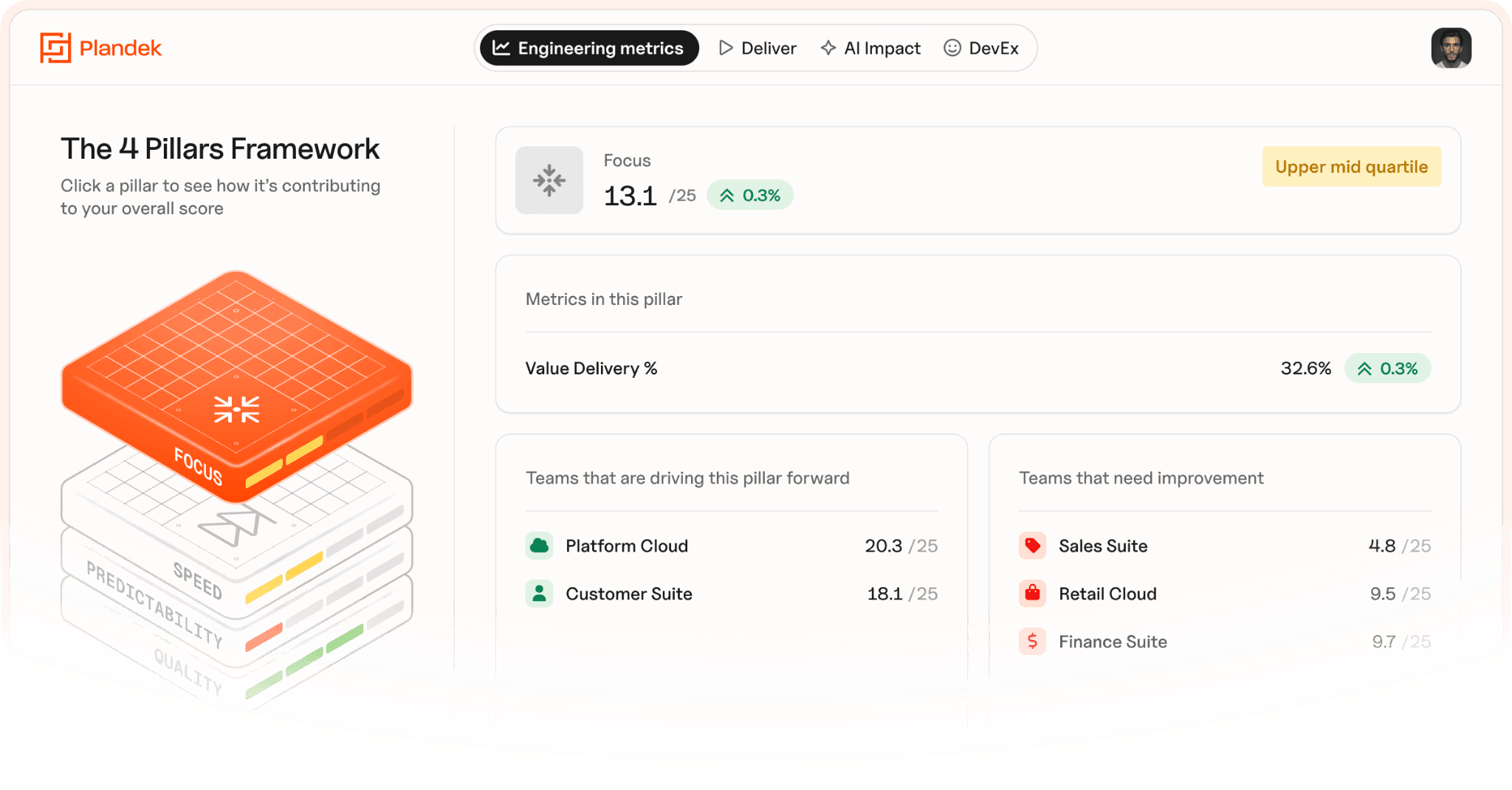
With Plandek, you can track and drill into:
the core KPIs behind each pillar, from Value Delivery % to Lead Time to Value, Sprint Target Completion and defect ratios
the constraints behind the numbers, including PR bottlenecks, scope change, carryover, review latency and quality drag
the real impact of AI, including whether AI adoption is improving delivery outcomes or simply shifting pressure downstream
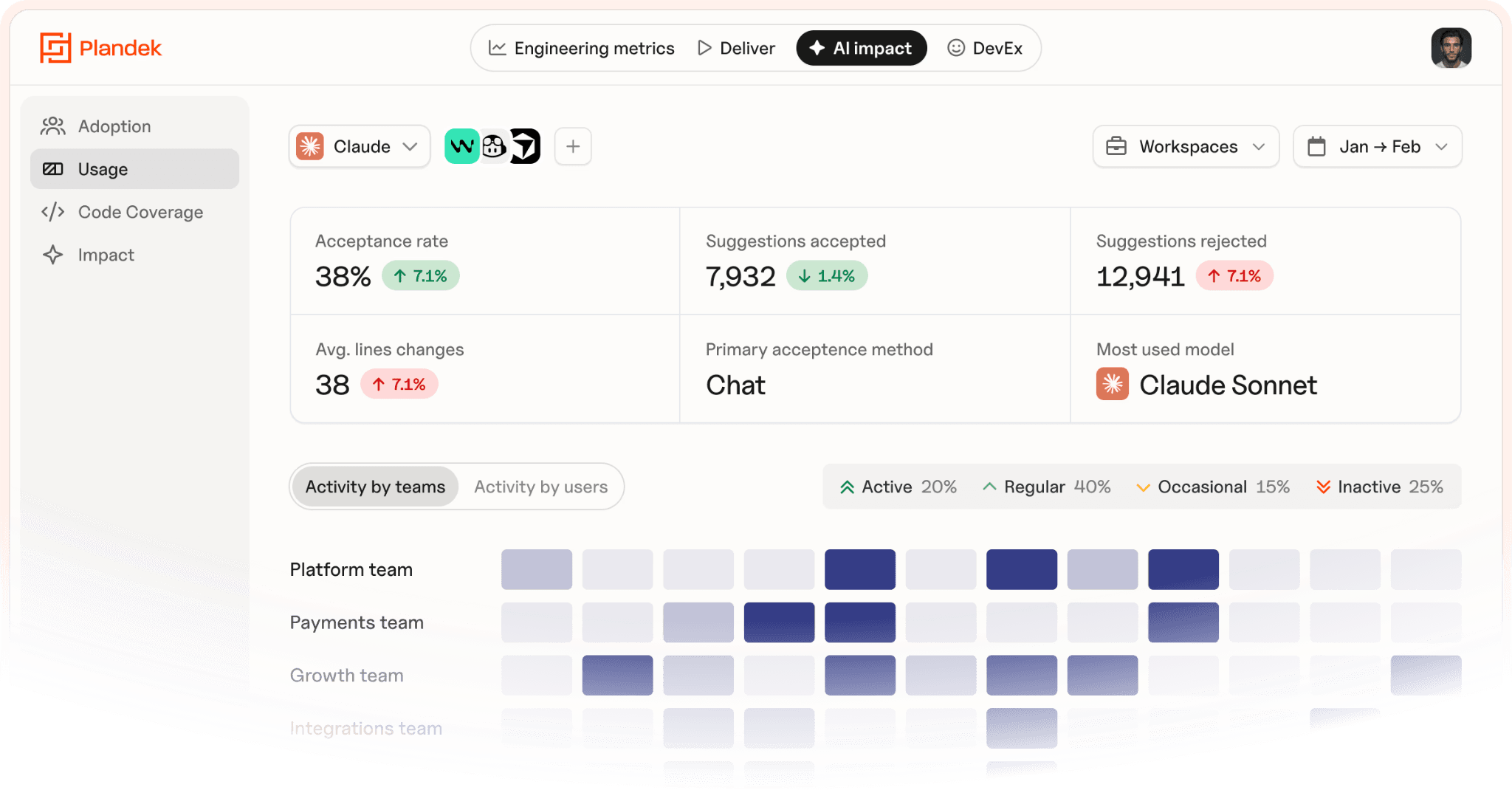
Plandek is also built for best-in-class tailorability. You can shape metrics, dashboards, workflows, teams, value definitions and AI reporting around how your organization actually operates, rather than forcing your delivery model into a rigid analytics tool.
See how Plandek helps engineering leaders improve delivery with the right KPIs.
Key takeaways
Engineering KPIs need context. More metrics do not automatically create better visibility.
Activity is not productivity. More code, PRs, or commits only matter if delivery improves.
The Four Pillars give balance. Focus, Speed, Predictability, and Quality show how the system is performing.
Metrics move together. Improving speed can hurt quality or predictability if constraints are ignored.
AI must be measured by outcomes. Adoption and usage are useful, but delivery impact is what matters.
The goal is system understanding. Good KPIs show where work is slowing down, drifting, or creating rework.
FAQs
What are software engineering KPIs?
Software engineering KPIs are metrics used to understand how effectively engineering teams deliver software. Useful KPIs measure outcomes such as delivery speed, predictability, focus, and quality.
What are the most important software development KPIs?
The most important software development KPIs measure delivery across four areas: Focus, Speed, Predictability, and Quality. Key metrics include Value Delivery %, Lead Time to Value, Cycle Time, Time to Merge PRs, Sprint Target Completion, and defect ratios. Together, these show whether teams are delivering valuable work efficiently, reliably, and without creating future rework.
What are the best software engineering KPIs?
The most important software engineering KPIs include Lead Time to Value, Cycle Time, Time to Merge PRs, Sprint Target Completion, Value Delivery %, and defect-related metrics.
How do you measure engineering productivity?
Engineering productivity should be measured across multiple dimensions, including whether teams are working on valuable work, how efficiently work flows, how reliably teams deliver, and whether quality is sustainable.
What is the Four Pillars framework?
The Four Pillars framework is a model created by Plandek, for measuring engineering productivity across Focus, Speed, Predictability, and Quality. It helps leaders understand performance as a system rather than a set of isolated metrics.


See how your engineering efforts translate into measurable business impact
Measure delivery performance, AI impact, and engineering productivity with hundreds of metrics, OOTB dashboards and custom configurations.












NEW
Contact us
UK Office
Unit 313 The Print Rooms, 164-180
Union St, London SE1 0LH
US Office
Floor 4, 1515 Mockingbird Ln,
Charlotte, NC 28209, USA