
The complete guide to the SPACE Framework for engineering leaders

Engineering teams are producing more output than ever. But more output hasn’t fixed delivery.
We are still seeing all of the same classic software engineering bottlenecks – unpredictable lead times, late-surfacing code quality issues, work stuck in reviews, handoffs, and hidden queues.
In other words, teams look busy, but outcomes don’t consistently improve.
That’s the gap the SPACE framework is designed to address. It gives leaders a better way to measure developer productivity beyond output alone.
It reframes productivity as a system problem – not just what teams produce, but how effectively they deliver value, collaborate, and sustain performance over time.
At Plandek, we see this pattern clearly in engineering productivity metrics and delivery data: activity scales faster than impact. Teams improve when they increase focus on roadmap delivery, remove flow bottlenecks, improve predictability, and protect quality – not when they simply produce more.
In this guide:
What is the SPACE framework?
How to measure and improve developer productivity with the SPACE framework?
When should you use the SPACE framework?
What is the difference between DORA metrics and SPACE?
What is the SPACE framework?
The SPACE framework is a model for measuring software engineering productivity across five dimensions:
Satisfaction and well-being
Performance
Activity
Communication and collaboration
Efficiency and flow
It was developed by researchers at Microsoft, GitHub, and the University of Victoria to challenge narrow productivity metrics like lines of code or commit volume.
Key idea: Developer productivity is multi-dimensional. You cannot understand it by looking at output alone.
Instead of prescribing a fixed set of metrics, SPACE encourages teams to combine quantitative system data with qualitative insights to get a more accurate picture of how engineering actually works.
Why the SPACE framework matters
Traditional software engineering productivity metrics focus on output and speed – commits, pull requests, velocity, deployments.
These signals are useful, but incomplete:
Activity is easy to inflate (especially with AI-assisted coding)
Output doesn’t equal impact
Speed without context hides trade-offs in quality and rework
Individual metrics distort team behavior rather than improve it
The SPACE framework was created to help solve this problem. SPACE introduces a broader lens:
How do developers feel about their work?
Are teams delivering meaningful outcomes?
Is work flowing smoothly or getting stuck?
Are teams collaborating effectively?
The shift: from measuring output → to understanding systems.
When code generation increases, activity scales quickly, but software development bottlenecks, quality issues, and coordination gaps don’t disappear. In many cases, they become more visible.
The five dimensions of SPACE explained
Each dimension captures a different part of engineering effectiveness. The value comes from combining them, rather than optimising one in isolation.
SPACE: Satisfaction and well-being
What it is:
How developers feel about their work, environment, and team.
What it reveals:
Risk of burnout or disengagement
Retention and morale trends
Friction in tools or processes
Example metrics:
Developer surveys (satisfaction, stress, autonomy)
Work-life balance indicators
Psychological safety signals
What to watch for:
Drops in satisfaction often show up before delivery metrics degrade. If cycle time or quality is slipping, the underlying issue is often already visible in team sentiment.
SPACE: Performance
What it is:
The outcomes of engineering work – how effectively software delivers value.
What it reveals:
Whether teams are building the right things
System reliability and quality
Impact on users and business outcomes
Example metrics:
Change failure rate
Mean time to recovery (MTTR)
Feature impact or adoption
Customer-facing quality signals
What to watch for:
High output with weak outcome signals (e.g. low adoption, recurring issues) usually indicates misaligned priorities, not low productivity.
SPACE: Activity
What it is:
The volume and frequency of engineering work.
What it reveals:
Team workload and pace
Potential bottlenecks
Engagement levels
Example metrics:
Commit frequency
Pull request volume
Builds and deployments
Tickets completed
What to watch for:
Rising activity without improvements in cycle time, quality, or predictability is a sign of hidden inefficiency or rework.
SPACE: Communication and collaboration
What it is:
How effectively teams share information and work together.
What it reveals:
Coordination across teams
Dependency management issues
Knowledge sharing effectiveness
Example metrics:
PR review time and feedback quality
Cross-team collaboration frequency
Meeting effectiveness
Documentation quality
What to watch for:
Delays in reviews, unclear ownership, or heavy back-and-forth are often the real bottleneck, even when coding speed looks high.
SPACE: Efficiency and flow
What it is:
How smoothly work moves through the development process.
What it reveals:
Bottlenecks and delays
Interruptions and context switching
Overall delivery efficiency
Example metrics:
Cycle time
Lead time
Time in review
Work-in-progress levels
What to watch for:
If total delivery time is high but active work time is low, the issue is not speed – it is waiting, handoffs, or workflow constraints.
The SPACE framework is useful because it broadens the definition of productivity. But for engineering leaders, the next challenge is operational: turning those signals into clear decisions about where to intervene.
For most engineering leaders, that understanding eventually needs to translate into a simpler set of delivery questions: are we focused on the right work, moving quickly, delivering predictably, and maintaining quality?
SPACE vs DORA metrics
The SPACE framework is often compared to DORA metrics, but they serve different purposes.
The key difference
DORA focuses on delivery performance – especially speed and stability
SPACE focuses on broader team effectiveness – including well-being, collaboration, activity, and flow
Aspect | SPACE | DORA |
Scope | Holistic (people, process, flow) | Delivery pipeline |
Focus | Team effectiveness | DevOps performance |
Metrics | Flexible, multi-dimensional | 4 fixed metrics |
Best for | Understanding productivity systems | Measuring delivery performance |
When DORA is enough
When we compare DORA vs SPACE Framework, DORA is often enough when:
you want to improve deployment speed and reliability
you need clear, measurable delivery KPIs
your main challenge is pipeline performance
When SPACE adds value
SPACE becomes more useful when:
teams are busy but delivery is still unpredictable
you want to understand why performance looks the way it does
you need visibility into collaboration, flow, and well-being
you want a broader definition of productivity than delivery metrics alone can provide
In practice, many mature teams use both. DORA helps you understand how software delivery is performing. SPACE helps you understand what conditions are shaping that performance.
The gap between broad frameworks and daily execution
The problem is that engineering leaders are often left choosing between two imperfect views:
a narrower delivery framework that is useful, but limited
a broader productivity framework that is insightful, but harder to operationalise
That is where Plandek’s Four Pillars of Engineering Productivity can offer a useful lens.
Rather than replacing DORA or SPACE, the Four Pillars simplify the day-to-day leadership questions that sit underneath both:
Focus – are we working on the right things?
Speed – are we delivering efficiently?
Predictability – are we delivering consistently?
Quality – are we working in a way that protects long-term performance?
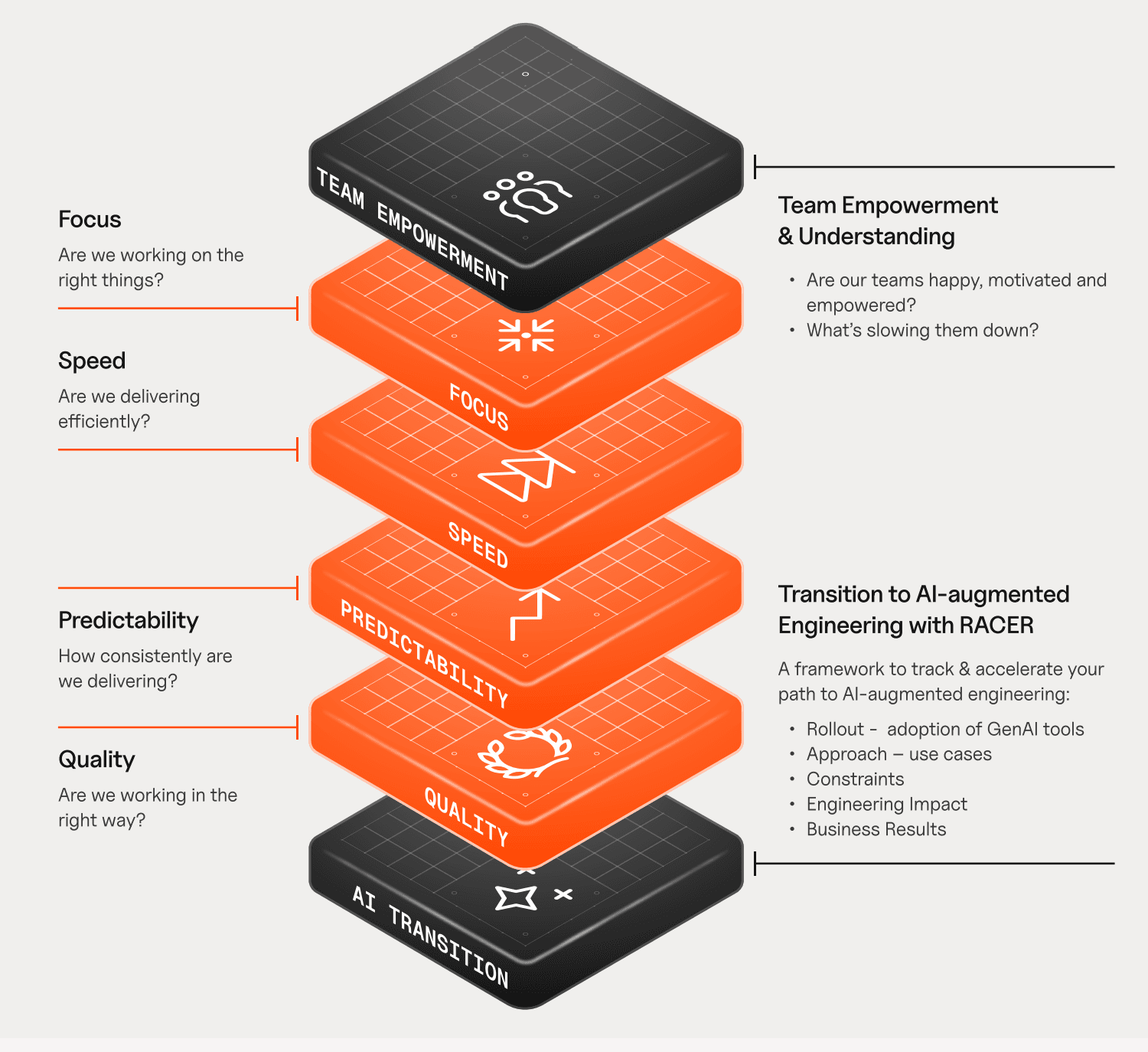
Learn about the Four Pillars of Software Engineering Productivity here.
This matters because, in practice, engineering leaders do not just need more metrics. They need a way to interpret trade-offs.
The Four Pillars don’t need to replace frameworks like DORA or SPACE. They can sit on top of them, helping leaders interpret trade-offs and decide where to intervene.
That is why the most useful measurement models tend to combine both perspectives:
the breadth of frameworks like SPACE
the delivery discipline of DORA
and a simpler operating lens for improvement, built around focus, speed, predictability, and quality
When should you use the SPACE framework?
The SPACE framework is most useful when you need a broader, more accurate view of engineering productivity than delivery metrics alone can provide.
Use it when:
output metrics are no longer giving clear answers
teams appear active, but outcomes are inconsistent
delivery feels slower or less predictable than activity levels suggest
you suspect hidden bottlenecks, workflow friction, or collaboration issues
developer satisfaction or burnout is becoming a risk
you want to align engineering performance with business impact, not just volume of work
In practice, SPACE is most valuable when leaders realise that productivity problems are rarely isolated.
This is why we recommend moving from broad frameworks like SPACE to a simpler operational lens – focusing on the Four Pillars focus, speed, predictability, and quality – to understand where intervention will have the most impact.
When the SPACE framework is not the right fit
SPACE is not always the right starting point.
Avoid it when:
you are an early-stage team with minimal process maturity
you need quick, short-term delivery improvements
leadership is not prepared to act on what the data reveals
you are looking for a single “productivity score”
your immediate need is tighter operational control, not broader diagnosis
SPACE works best as a thinking framework. It helps teams understand complexity, but it does not provide a step-by-step model for improving outcomes.
That gap becomes more visible in AI-augmented engineering.
Teams can successfully roll out AI tools and see increased activity – more code, more PRs, more suggestions – without meaningful improvement in delivery performance.
Closing that gap requires more than measurement. It requires a structured way to connect:
adoption
ways of working
delivery constraints
and engineering outcomes
How to implement SPACE metrics in practice
The biggest mistake teams make with the SPACE framework is trying to measure everything at once.
A better approach is deliberate, focused, and tied to the problems you are actually trying to solve.
1. Start with the problem, not the framework
Do not start by asking, “Which SPACE metrics should we track?”
Start by asking:
Where is work slowing down?
Why is software engineering delivery unpredictable?
Where are teams struggling?
Are we seeing trade-offs between speed, quality, and focus?
That gives your metrics a job to do.
2. Select a small, balanced set of metrics
Choose 1–2 metrics per dimension based on your current priorities.
Avoid building a dashboard of everything. The goal is not coverage. The goal is insight.
3. Combine quantitative and qualitative data
Use both:
system data such as cycle time, lead time, PR flow, deployment patterns
team input such as surveys, retrospectives, and qualitative feedback
Without system data, you miss what is happening in the workflow. Without team input, you miss why it is happening.
4. Focus on teams, not individuals
SPACE is designed for team-level understanding.
Using it for individual performance management usually leads to:
gaming behavior
worse collaboration
lower trust
noisier data
5. Establish baselines and look for trends
Single data points are often misleading.
Focus on:
trends over time
differences between teams or work types
changes after specific interventions
That is how you separate signal from noise.
6. Use metrics to understand trade-offs, not just performance
Metrics should help you understand how different aspects of delivery interact.
For example:
high activity + low satisfaction → unsustainable pace
fast cycle time + rising defects → quality trade-offs
strong throughput + poor predictability → planning instability
This is where many teams struggle with SPACE in practice. The framework highlights multiple dimensions, but does not prioritize them.
A useful next step is to simplify those signals into four core delivery questions:
Focus – are we spending enough capacity on roadmap value?
Speed – is work moving efficiently through the system?
Predictability – are we delivering consistently?
Quality – are we maintaining standards as we scale output?
This creates a clearer way to reason about trade-offs and decide where to act.
7. Evolve your approach as your delivery model changes
Your metric strategy should evolve as your organization matures, your bottlenecks shift, your workflows change, or your use of AI tools increases
But as teams adopt AI, something important changes.
You are no longer just measuring delivery performance – you are managing a system in transition.
It is not enough to track outcomes like cycle time or deployment frequency. You also need to understand:
how widely AI tools are being used
how they are being used (assist vs agent vs autonomous)
which constraints in the SDLC are limiting their impact
whether improvements are translating into real delivery and business results
This is where we see many teams get stuck, and it happens when they successfully roll out AI tools, but struggle to turn usage into measurable impact. SPACE doesn’t fully address this.
SPACE helps you understand the system, but it does not tell you how to move the system forward.
That is where Plandek’s RACER framework comes in.
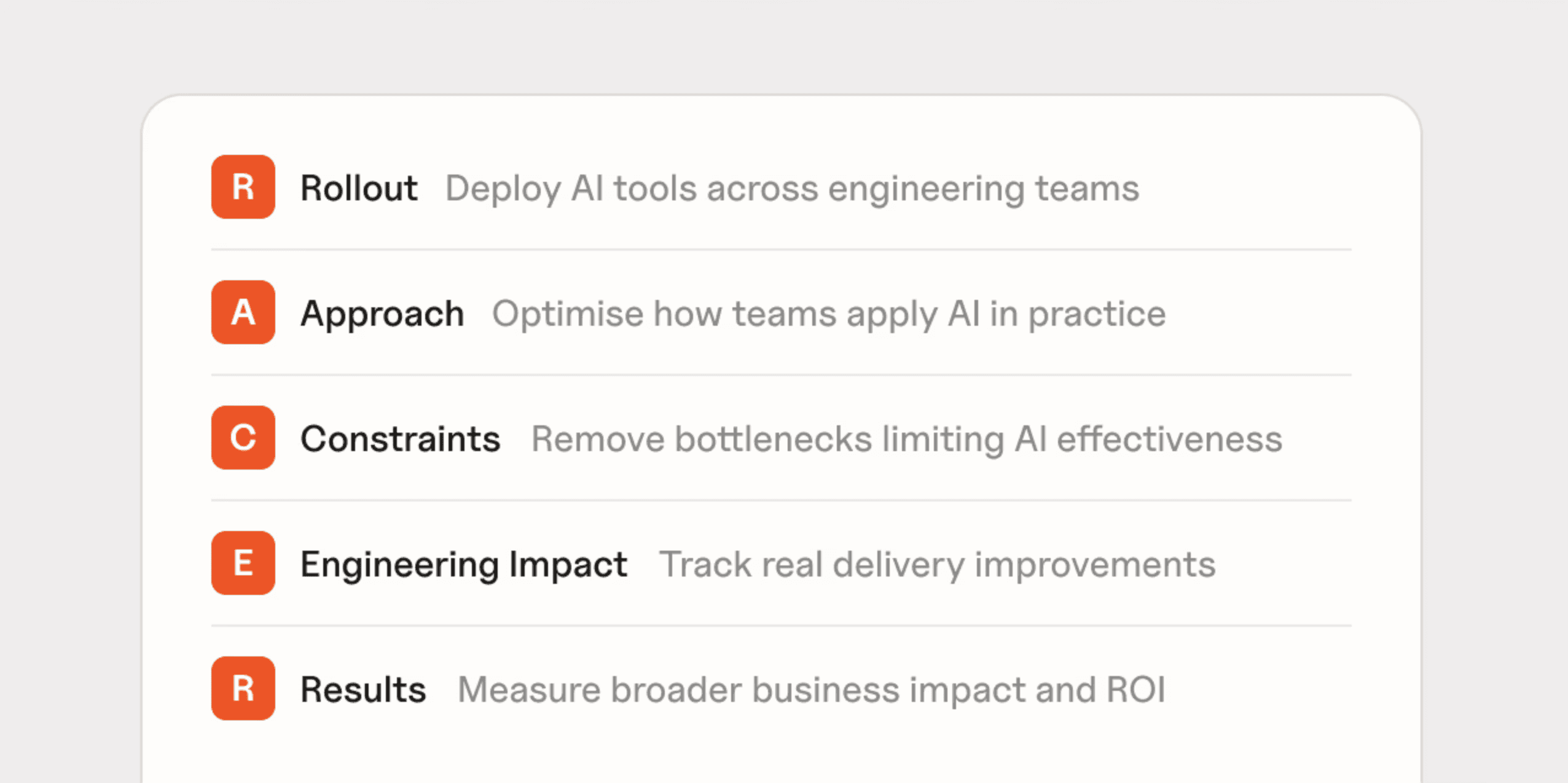
RACER provides a structured way to move from experimentation to results:
Rollout – are tools being adopted and used effectively?
Approach – are teams using the right patterns (assist, agent, autonomous) for the task?
Constraints – what is limiting impact across the SDLC (reviews, architecture, process)?
Engineering Impact – are core delivery metrics actually improving?
Results – is this translating into business outcomes like faster time to market or reduced cost?
This reflects the progression many teams go through:
from measuring activity → to understanding delivery systems (SPACE) → to actively managing improvement and outcomes (RACER)
As AI increases output, the constraint shifts away from coding itself and into the broader system – reviews, workflows, prioritization, and quality.
Without a structured approach, teams risk scaling activity without improving delivery.
RACER exists to make that transition measurable, repeatable, and aligned to real outcomes.
👉 Learn about the RACER Framework and see where your delivery is actually slowing down
Common mistakes teams make with SPACE
These are the mistakes that show up most often:
Over-indexing on activity metrics
Measuring too much too early
Turning team metrics into individual scorecards
Ignoring flow and bottlenecks
Collecting survey data without acting on it
Treating SPACE as a fixed checklist
Assuming more AI activity means more engineering productivity
The framework is useful. Misuse is what creates problems.
That last mistake matters more now than ever.
In AI-augmented environments, this creates a new failure mode:
high adoption, low impact
Teams successfully roll out tools, but underlying constraints – in review, planning, architecture, or workflow – prevent those gains from translating into better outcomes.
This is why measuring adoption alone is not enough. Leaders need to understand:
how tools are being used
where constraints exist
how delivery performance is changing
and whether any of this is creating real business value
Without that, productivity metrics become noise again – just at a higher volume.
The limitations of the SPACE framework
The SPACE framework is valuable, but it is not a complete solution.
It is a framework, not an operating model
Some dimensions are hard to measure consistently
It does not explicitly center predictability, despite its importance
It does not connect metrics directly to delivery trade-offs or business outcomes
It becomes harder to interpret in AI-augmented environments, where activity scales faster than impact
This is where many teams stall.
They collect more data, but still cannot clearly answer:
where value is being lost
which constraints matter most
whether improvements are real or superficial
In practice, teams need two additional layers:
a simpler operational model to interpret productivity signals (e.g. focus, speed, predictability, quality)
a structured way to manage change, especially with AI (from rollout → to real impact → to business results)
Without those, even well-designed frameworks like SPACE remain descriptive rather than actionable.
Applying SPACE effectively with better visibility
To make the SPACE framework actionable, teams need more than metrics. They need visibility into how work actually moves through the system.
That includes understanding:
where work is waiting
how long it takes to deliver value
how stable delivery really is
where quality issues originate
whether increased activity is translating into better outcomes
This is where combining different lenses becomes powerful:
a broad framework like SPACE to understand productivity
a simpler operational model (focus, speed, predictability, quality) to guide decisions
and a structured approach to change (like RACER) to manage adoption, constraints, and outcomes in AI-augmented environments
Platforms like Plandek sit across all three layers – connecting signals from across the SDLC, exposing constraints, and helping teams understand whether changes are improving delivery in a measurable way.
Because ultimately, the goal is not to measure productivity.
It is to improve it – consistently, and at scale.
How Plandek helps you apply SPACE in practice
Plandek gives you a system-level view of your SDLC, so you can see how work actually flows – and where it breaks across four operational concerns:
Focus – how much capacity is spent on roadmap work vs unplanned work
Speed – where work is waiting and how long it takes to deliver value
Predictability – how consistently teams deliver against plans
Quality – whether increased output is creating more defects or rework
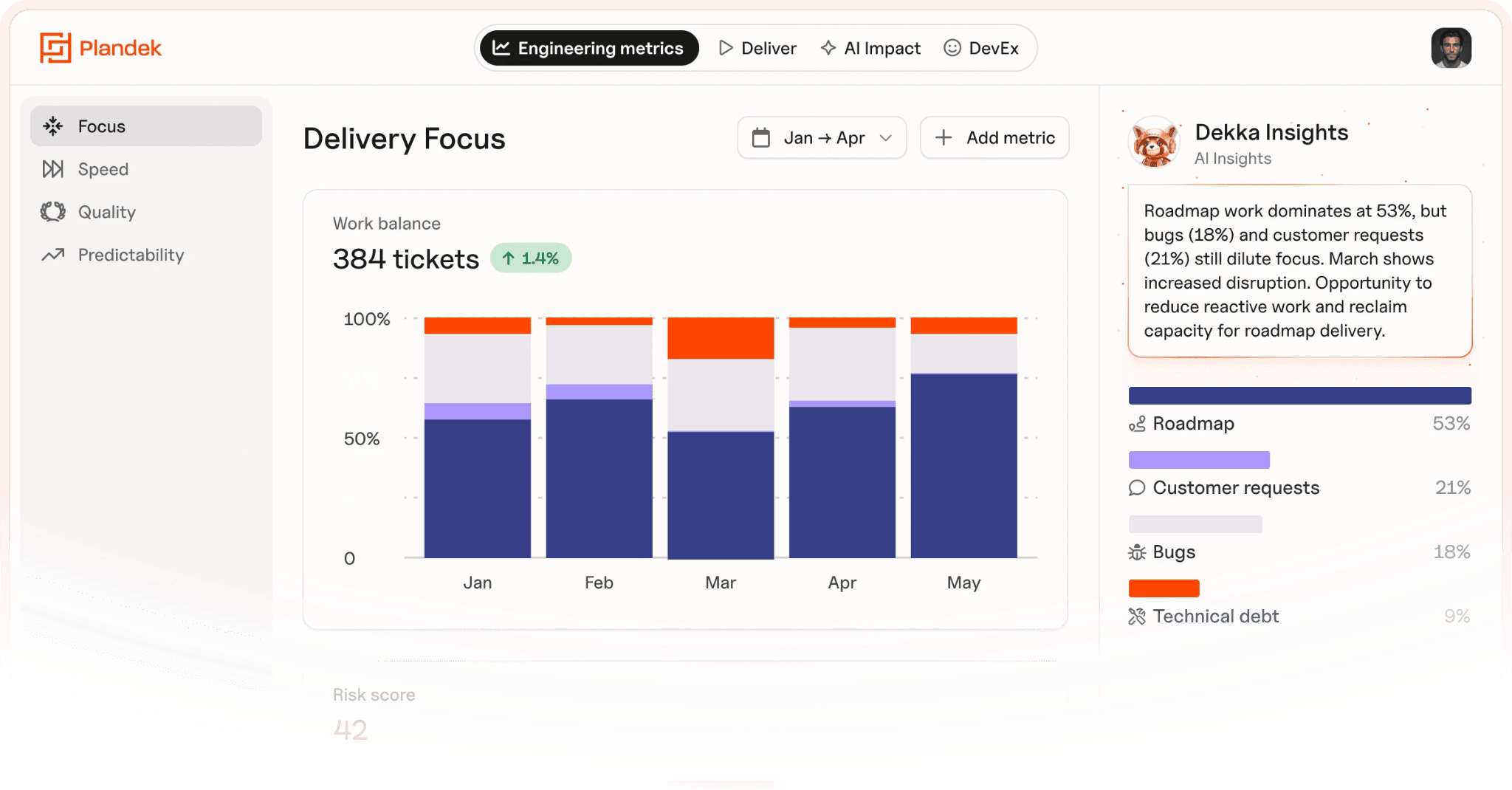
Instead of interpreting metrics in isolation, you can identify the constraint that is actually limiting delivery – and measure whether changes improve overall performance.
In AI-augmented engineering, this becomes critical.
Plandek helps you understand:
whether increased activity is improving delivery – or just exposing new bottlenecks
where constraints are emerging across review, testing, and workflow
how AI adoption is affecting real engineering outcomes
This is where the RACER framework comes into play – giving you a structured way to move from rollout to measurable results across adoption, constraints, engineering impact, and business outcomes.
👉 See how Plandek gives you system-level visibility across your SDLC
Frequently asked questions about the SPACE framework
What is the SPACE framework in software engineering?
The SPACE framework is a model for measuring software engineering productivity across five dimensions: Satisfaction and well-being, Performance, Activity, Communication and collaboration, and Efficiency and flow.
Is the SPACE framework better than DORA metrics?
The SPACE framework is not a replacement for DORA metrics; DORA focuses on delivery performance, while SPACE provides a broader view of team effectiveness, so many teams use both together.
When should you use the SPACE framework?
You should use the SPACE framework when output and delivery metrics are not explaining performance clearly and you need a broader view of productivity, including flow, collaboration, and developer experience.
What are examples of SPACE metrics?
SPACE metrics include cycle time, lead time, deployment frequency, PR review time, developer satisfaction scores, and indicators of collaboration and flow across the SDLC.
How does AI impact SPACE metrics?
AI increases activity metrics such as code output and commits, but does not automatically improve delivery outcomes, making it more important to measure flow, quality, predictability, and real impact.


See how your engineering efforts translate into measurable business impact
Measure delivery performance, AI impact, and engineering productivity with hundreds of metrics, OOTB dashboards and custom configurations.












NEW
Contact us
UK Office
Unit 313 The Print Rooms, 164-180
Union St, London SE1 0LH
US Office
Floor 4, 1515 Mockingbird Ln,
Charlotte, NC 28209, USA