


While the key objective of Agile software development is the early and continuous delivery of valuable software, it can be difficult to know if you're successful.
At Plandek, we think the trick is finding a simple set of four metrics that your teams can understand and trust. This helps to deliver rapid, sustainable and significant improvement to your delivery outcomes.
We call these critical metrics ‘North Star’ metrics – they set the direction for the whole engineering organisation. They need to be carefully selected to be meaningful when aggregated and illustrative of effective software delivery. The four key metrics provide a rounded view of your software development process:
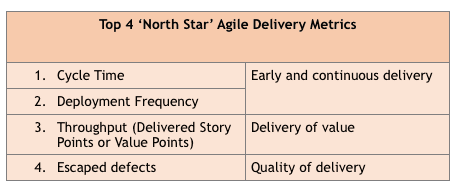
Figure 1. Top 4 ‘North Star’ Agile Delivery Metrics
Cycle Time
Cycle Time is a crucial metric for all engineering teams. It measures the time from starting work on a feature or bug until it’s in production. Unlike the broader measure of Lead Time, which includes the time spent in product refinement and on the backlog, Cycle Time is easier to influence as it looks only at the time which is in the control of the team.
The Cycle Time metric view allows teams to understand the time spent in each ticket status within the development cycle. Plandek has flexible analytics capability and powerful filtering to allow analysis by Status, Issue Type, and Epic (and any other standard or custom ticket field), all plotted over any time range required.
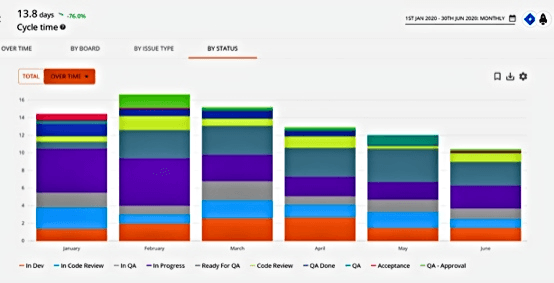
Figure 2. Example Plandek Cycle Time metric view
Deployment Frequency
Deployment Frequency is another fundamental measure of an organisation’s ability to deliver value rapidly. Key to achieving the Agile objective of rapid and continual delivery of software is developing the capability to develop and deploy small software increments rapidly. Deployment Frequency tracks that competence and is a powerful metric around which to focus effort at all levels in the delivery organisation.
Delivered Story Points
Delivered Story Points is often considered a problematic metric due to the potential inconsistencies in the calculation of story points and how much effort they represent. However, as a basic measure of output and how that is trending over time, it is a powerful metric around which to align.
There may be concerns about teams ‘gaming’ the metric with story point inflation, but as with all metrics, they should be viewed in context by experienced folks who know the teams well. It is also not large numbers of story points that signify success but consistency.
Escaped Defects
Escaped Defects is a simple but effective measure of overall software delivery quality. It can be tracked in several ways, but typically, teams use either a priority or a label on bugs.
When these four simple Agile delivery metrics are viewed together, you get a balanced view of how your organisation is doing at building software, and you can use them to underpin a powerful continuous improvement process at the team level.
Using these metrics to increase Velocity and Deployment Frequency
This metrics-led approach to continuously improving Agile delivery effectiveness can be highly effective.
A major Plandek enterprise client in the travel technology sector uses Plandek to underpin a metrics-led approach to continuously improving their software delivery process. As a result, over the past 24 months, using a simple set of Agile delivery metrics surfaced in Plandek’s customisable dashboards, the client has:
Reduced Cycle Time by 75%
Reduced hotfixes in production by 54%
Doubled commit frequency by Engineers
15% average increase in deployments per day
Written by
Charlie Ponsonby
Co-founder & CEO
Charlie Ponsonby is CEO and Co-founder of Plandek, the leading Developer Productivity Insight (DPI) platform that helps software engineering teams drive productivity and transition to AI-led engineering. He writes widely on the opportunities and challenges inherent in the transition to the agentic SDLC. Prior to founding Plandek, Charlie founded Simplydigital, which grew to become the UK's largest broadband and digital services comparison business before being acquired by Europe's largest consumer electronics retailer. He started his career at Accenture and has held senior leadership roles in retail and telco. Charlie holds a degree from the University of Cambridge.


See how your engineering efforts translate into measurable business impact
Measure delivery performance, AI impact, and engineering productivity with hundreds of metrics, OOTB dashboards and custom configurations.









Contact us
UK Office
Unit 313 The Print Rooms, 164-180
Union St, London SE1 0LH
US Office
Floor 4, 1515 Mockingbird Ln,
Charlotte, NC 28209, USA