
Introducing the AI Transition Playbook: from AI adoption to engineering impact

Najmen Akhtar

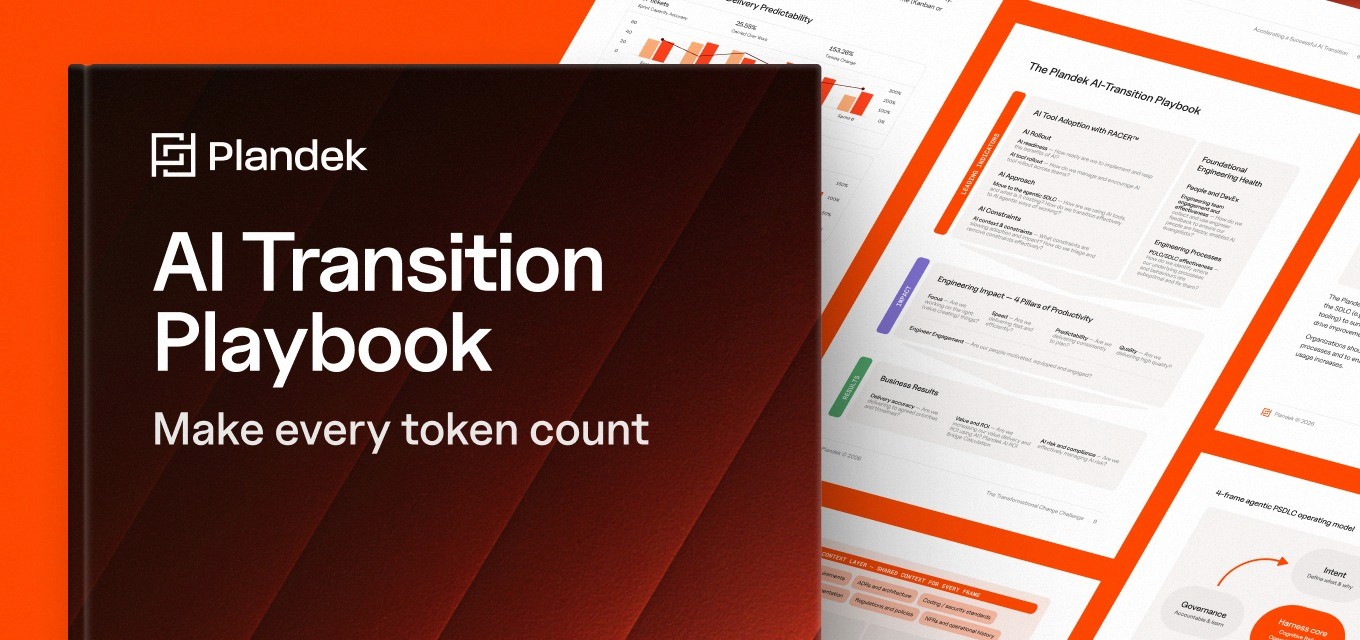
Built from data across 2,500+ software engineering teams, current research and direct input from technology leaders, the AI Transition Playbook is a practical guide to making the move to agentic software development – and making it pay.
Are AI agents speeding up your developers, but not your engineering output?
One 2026 study found that asynchronous agents drove a 17x increase in code creation, but only a 30% increase in software released. That is still a significant gain, but it exposes one of the biggest challenges technology leaders face right now.
AI can accelerate an activity without accelerating the system around it.
Most organizations naturally pay attention to AI adoption at one end, and AI ROI at the other. The important part is what happens in between.
The AI conversation has moved on
While leaders are still talking about which AI tools to adopt and how quickly they could get them into developers’ hands, many organizations find these are no longer the difficult questions..
Now, we’re asking: is adoption producing meaningful productivity gains?
The AI Transition Playbook
The AI Transition Playbook focuses on what you need to do in practice.
It draws on engineering data and benchmarks from more than 2,500 teams, Plandek’s work with organizations actively adopting AI and agentic development, input from CTOs and other technology and AI leaders, and the latest academic and industry research into engineering productivity, AI adoption, economics and risk.
This is a playbook for managing the much bigger change happening around us.
The Playbook explains everything you need to know about how to understand whether your organization is truly ready for agentic AI.
We cover:
Can you measure the journey from idea to production? Without a reliable baseline, you cannot tell whether AI is improving the system or simply increasing activity.
Where are gains getting lost? What constraints in your system are limiting the improvement of business outcomes, and do you know how to find and fix them?
Is your engineering data clean and connected? Agents – and the teams measuring them – need usable signals across tickets, code, reviews, testing and deployment.
Is your codebase ready for agents? Good documentation, architecture, tests and repository-level context determine whether agents produce work that actually fits your system.
Are your workflows explicit enough for agents to follow? Tribal knowledge, ambiguous requirements and informal handoffs become much bigger problems when humans are no longer executing every step.
Are your people ready for the shift? More agent output changes roles, review load and accountability – and can quickly turn experienced engineers into the next bottleneck.
Can you prove your AI use is controlled? As autonomy rises, you need visible human oversight, guardrails, audit trails and clear accountability; not simply an AI policy.
When agents scale faster than the organization around them, the problems scale too: security exposure, defects, technical debt, overloaded reviewers, lost institutional knowledge and disappointing ROI.
The Playbook also looks at two foundations that increasingly separate effective agentic teams from everyone else: context engineering, which gives agents the map they need to make good decisions, and harness engineering, which provides the controls that stop bad ones reaching production.
Make every token count
The first phase of AI adoption rewarded experimentation. But as usage scales, so does the bill, and the pressure to prove what that spend is actually delivering.
Now, we need to know how much value we are getting from every token.
That means looking beyond usage and token spend in isolation. You need to understand whether AI investment is creating more useful engineering output after review, rework, downstream constraints, quality and risk are taken into account; and whether those gains are translating into faster time to market, greater innovation capacity or lower cost.
The Playbook shows you how to make every token count, and how to apply Plandek’s RACER™ framework, which connects Rollout and Approach to Constraints, Engineering Impact and ultimately business Results.
A practical guide for wherever you are starting
The AI Transition Playbook will help you understand where you stand, identify what is preventing you from moving faster, and build a more deliberate path toward agentic development, without treating every new AI capability as another tool rollout.
You can download the AI Transition Playbook here.
Written by
Najmen Akhtar
Head of Marketing
Najmen is Head of Marketing at Plandek, with over 10 years’ experience in the technology industry, including at Splunk, Expedia and Lattice. She writes about engineering productivity, technology leadership and the role of data in building high-performing engineering organisations.


See how your engineering efforts translate into measurable business impact
Measure delivery performance, AI impact, and engineering productivity with hundreds of metrics, OOTB dashboards and custom configurations.










NEW
NEW
Contact us
UK Office
Unit 313 The Print Rooms, 164-180
Union St, London SE1 0LH
US Office
Floor 4, 1515 Mockingbird Ln,
Charlotte, NC 28209, USA