
DORA vs SPACE metrics in AI-Enabled Engineering
What drives engineering performance: speed, or the people behind it?
Frameworks like DORA and SPACE were created to answer that question from different angles. DORA metrics measure how efficiently software is delivered. The SPACE framework, and SPACE metrics, look at the broader conditions that shape software development productivity, from collaboration to well-being. Both are widely used DevOps metrics frameworks, but they solve different problems.
In AI-enabled environments, output is increasing faster than impact. AI rolled out without a concrete strategy can sometimes stall or even slow development. That makes choosing the right engineering productivity metrics – and understanding what they actually mean – more important than ever.
In this guide:
What are DORA metrics vs SPACE framework and how do they work?
How does AI change the value and limits of both?
When are DORA and SPACE metrics useful, and what are their limitations?
What are the Four Pillars of Software Engineering Productivity?
What are DORA metrics?
DORA metrics measure software delivery performance, specifically the speed and stability of your delivery pipeline, using four signals:
Deployment frequency
Lead time for changes
Change failure rate
Mean time to restore
They answer a simple but critical question: “How efficiently and reliably are we delivering software?”
DORA provides a clean, outcome-focused view of delivery.
What is the SPACE framework?
The SPACE framework measures developer productivity as a system, not just output, across five dimensions:
Satisfaction and well-being
Performance
Activity
Communication and collaboration
Efficiency and flow
It answers a different question: “What conditions are shaping our ability to deliver effectively?”
SPACE is useful because it moves beyond activity and captures flow, coordination, and sustainability – the factors that actually determine whether delivery performance improves.
The trade-off is that SPACE is less prescriptive. It improves understanding, but does not directly tell you where to act. This is why SPACE is often more useful alongside flow metrics, not output metrics alone.
Read our complete guide to the SPACE framework
Comparing DORA vs SPACE
DORA metrics | SPACE framework | |
What it is best at | DORA is best for measuring software delivery performance. It shows whether software is moving through the pipeline quickly and reliably. | SPACE is best for understanding the wider conditions behind productivity. It helps explain whether teams can sustain performance, collaborate well, and move work through the system effectively. |
What question it answers | “How well is our delivery system performing?” | “What is shaping that performance?” |
What kind of signal it gives | A direct operational signal. DORA is useful when leaders want to know whether speed and stability are improving or deteriorating. | A diagnostic signal. SPACE is useful when leaders need to understand whether issues in flow, collaboration, workload, or team health are contributing to delivery problems. |
What it misses | DORA does not explain why delivery metrics are changing. If lead time worsens, it will not tell you whether the issue is review overload, poor coordination, rework, weak prioritisation, or burnout. | SPACE does not give the same clear operational baseline as DORA. It can show that productivity is multi-dimensional, but it does not always make it obvious where leaders should intervene first. |
How it behaves in AI-enabled environments | AI makes DORA more necessary and less sufficient. As code throughput rises, DORA can reveal worsening lead time, failure rate, or recovery performance, but it cannot tell you whether the root cause sits in reviews, testing, workflow design, or quality control. | AI makes SPACE more relevant because output becomes less trustworthy as a proxy for productivity. It helps leaders ask whether higher activity is translating into outcomes, or whether teams are simply pushing more work into the same constraints. |
Main risk if used badly | Leaders optimise for visible speed while missing the broader system. That can produce fragile gains: more throughput in the short term, more rework, instability, or delivery drag later. | Leaders collect too many signals without a clear operating model. That creates broader visibility, but not necessarily better decisions. |
When it is most useful | When the immediate leadership problem is delivery performance: slower releases, rising failure rates, or weak operational resilience. | When delivery metrics alone are no longer enough to explain what is happening, especially in environments with workflow friction, heavy coordination costs, or signs that higher activity is not leading to better outcomes. |
Takeaway | Use DORA to establish whether delivery is healthy. It is your baseline for speed and stability. | Use SPACE to understand whether the team and workflow conditions behind delivery are healthy enough to support sustained improvement. |
DORA vs SPACE: the real difference
The simplest way to think about the difference is this:
DORA measures delivery performance
SPACE measures the broader system conditions shaping that performance
DORA is narrower, but easier to operationalise. SPACE is broader, but harder to turn into day-to-day decisions.
Comparing them as competing frameworks misses the point.
DORA is strongest when:
you need a clear view of deployment speed and stability
you want simple delivery KPIs
your main challenge is release performance or pipeline health
SPACE is strongest when:
teams look busy but delivery is still inconsistent
you need to understand why performance looks the way it does
collaboration, workflow friction, or burnout may be affecting outcomes
activity is rising faster than impact
In practice, mature organizations often need both.
The Four Pillars of Productivity: Why AI changes the DORA vs SPACE debate
AI increases coding throughput, but it rarely removes the real constraints in delivery. More often, it shifts software engineering bottlenecks downstream into reviews, testing, coordination, and quality.
Read our Complete Guide to Software Engineering Bottlenecks here.
That creates a familiar pattern in AI-enabled teams: high activity, low impact. More code does not necessarily mean faster delivery, better predictability, or higher quality.
This exposes the limits of both frameworks.
DORA shows that delivery performance is changing, but not why
SPACE explains more of the system, but does not always make the next action clear.
So, we need a way to interpret trade-offs and decide where to intervene.
That is where Plandek’s Four Pillars of Engineering Productivity comes in.
The Four Pillars are an operating model that simplifies engineering productivity into four core delivery questions:
Focus – are we working on the right things? Faster output has no value if capacity is being consumed by rework, interruptions, or low-value work
Speed – is work moving efficiently through the system? Coding faster is not the same as delivering faster if work is waiting elsewhere
Predictability – are we delivering consistently? Higher activity is not progress if delivery becomes less reliable
Quality – are we protecting long-term performance as output scales? More output can increase hidden defects and downstream instability if controls do not keep pace
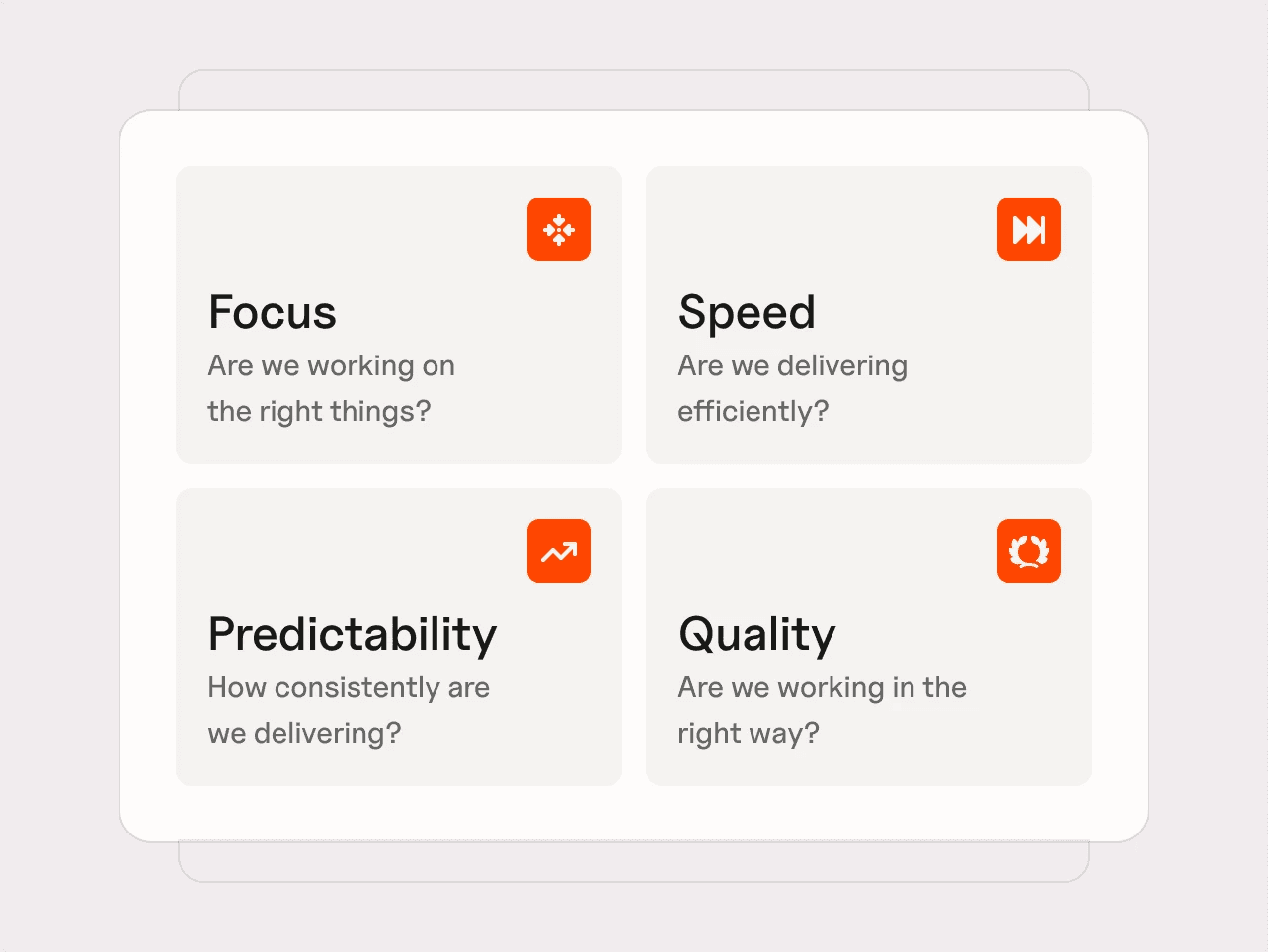
The Four Pillars enable leaders to reason about flow throughout an entire AI-enabled software development lifecycle.
Learn about the Four Pillars of Software Engineering Productivity here.
How Plandek helps you track software development productivity
Plandek helps you measure the core metrics behind the Four Pillars of Engineering Productivity – moving beyond narrow productivity signals to a clearer view of delivery performance and system health.
It gives you a system-level view of your SDLC, so you can see how work actually flows – and where constraints are limiting delivery across four core areas:
Focus – how much capacity is going to roadmap work vs unplanned work and rework
Speed – where work is waiting and how long it takes to move from commit to value
Predictability – how consistently teams deliver against expectations
Quality – whether increased output is creating defects, rework, or instability
Instead of interpreting DORA or SPACE metrics in isolation, you can measure the SDLC metrics that actually matter across the system – and identify the constraint that is driving performance.
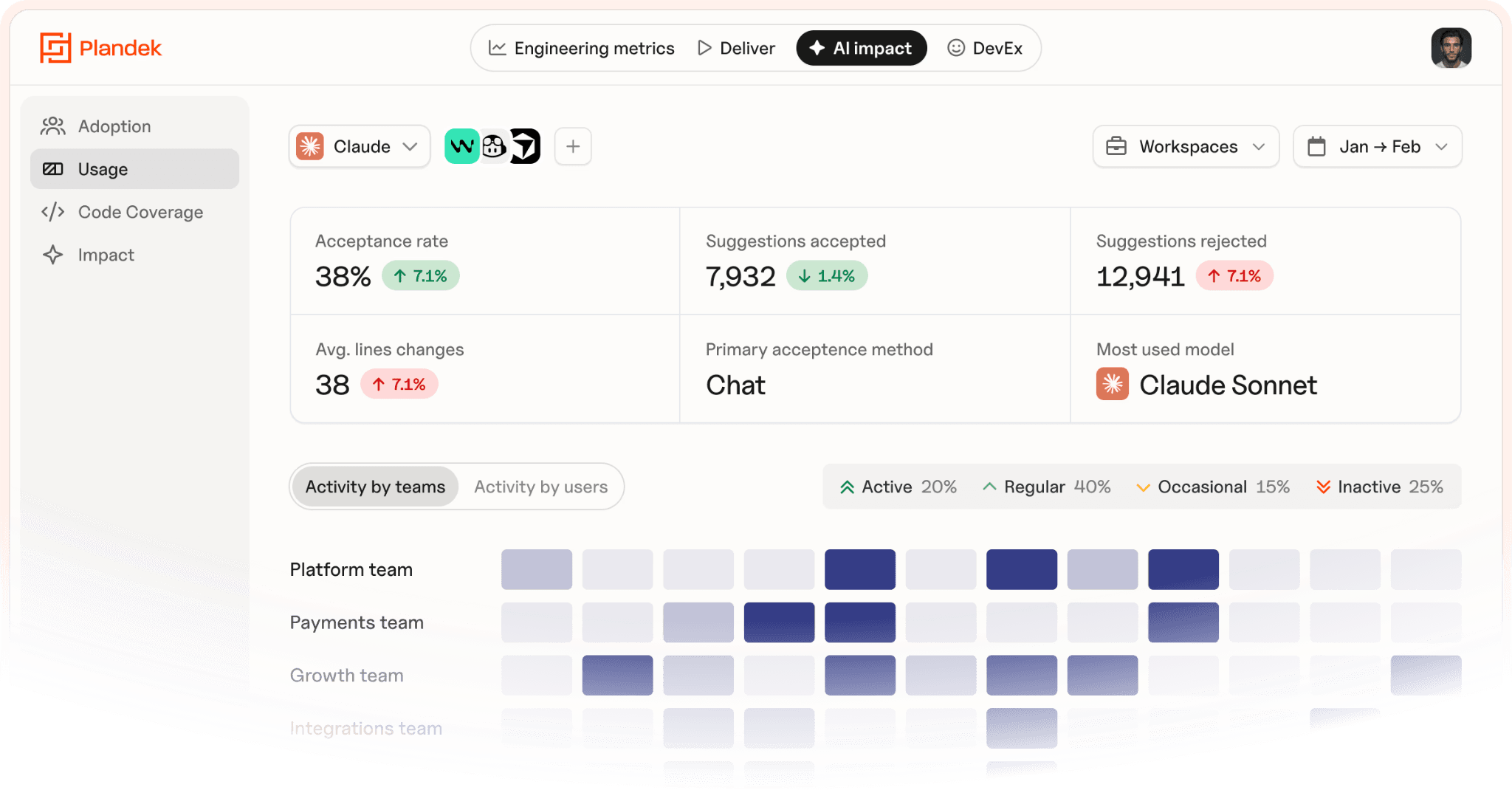
In AI-enabled environments, this becomes critical.
Plandek helps you understand:
whether increased activity is improving delivery – or just building up queues
where new bottlenecks are emerging as throughput increases
how flow, coordination, and quality are changing as AI adoption scales
This is how you move beyond measuring productivity to managing delivery as a system – improving outcomes without trading off speed, predictability, or quality.
👉 See how Plandek helps you identify and remove delivery constraints across your SDLC
Key takeaways
AI increases activity, not necessarily delivery – more code and more PRs do not automatically mean better software delivery
DORA and SPACE metrics still matter – but on their own, they do not fully explain AI’s impact on the SDLC
AI productivity is a system outcome – it depends on flow, quality, predictability, and value delivery, not just coding speed
The Four Pillars give a fuller view – focus, speed, predictability, and quality show whether delivery is actually improving
Many AI metrics are misleading in isolation – usage, PR volume, and AI-generated code percentage often signal activity, not impact
AI impact depends on constraints – if review, testing, or release remain bottlenecks, more activity will not translate into proportional gains
FAQs
What are AI productivity metrics in software engineering?
AI productivity metrics are the measures used to assess whether AI tools are improving software delivery, not just increasing activity. The most useful ones track speed, quality, predictability, and value delivery.
How do you measure AI productivity in engineering teams?
Measure AI productivity by looking at system-level delivery metrics such as Lead Time to Value, Cycle Time, defect ratios, and Value Delivery %, alongside signs of AI adoption and usage.
Are DORA metrics enough to measure AI impact?
No. DORA metrics remain important, but they do not fully explain how AI affects upstream bottlenecks, capacity allocation, or delivery predictability.
Which AI metrics are misleading for engineering leaders?
AI-generated code percentage, PR volume, commit volume, self-reported time saved, and tool usage alone can all mislead if treated as proof of productivity. They show activity more reliably than delivery impact.
Why doesn’t higher AI usage always improve software delivery?
Because AI often speeds up code generation first, while constraints in review, testing, planning, or release remain in place. That can increase throughput locally without improving end-to-end delivery.
What should engineering leaders measure to track AI productivity?
Engineering leaders should measure metrics across focus, speed, predictability, and quality, including Lead Time to Value, Time to Merge PRs, Sprint Target Completion, Bug Resolution Time, and Value Delivery %.


See how your engineering efforts translate into measurable business impact
Measure delivery performance, AI impact, and engineering productivity with hundreds of metrics, OOTB dashboards and custom configurations.












NEW
Contact us
UK Office
Unit 313 The Print Rooms, 164-180
Union St, London SE1 0LH
US Office
Floor 4, 1515 Mockingbird Ln,
Charlotte, NC 28209, USA